S4PIENS · Food
Pork
What it takes to make it, and what it does to the planet.
Producing one kilogram of pork emits about 12.3 kg of greenhouse gases (CO₂-equivalent) on average, placing it number 9 of 38 foods in the largest study of food systems, which covers 38,700 farms in 119 countries.
Each kilogram also takes about 17.4 square metres of land and 1,796 litres of fresh water.
China, United States and Brazil together produced 60% of the world's pork in 2024.
How it compares
Greenhouse gases from farm to shop, for every food in the study.
Where it comes from
The largest producers in 2024, in tonnes.
What it does to nature
Better choices
- Per 100 g of protein, pork emits about 7.6 kg CO₂e. The same protein from nuts (0.3), peas (0.4), beans and other pulses (0.8), peanuts (1.2) emits less.
Questions people ask
How much CO₂ does pork produce?
About 12.3 kg CO₂-equivalent per kilogram on average, from farm to retail (Poore & Nemecek 2018). That is number 9 of 38 foods in the study.
How much land does pork need?
About 17.4 m² per kilogram on average, including the land used to grow feed.
Where does pork come from?
The largest producers in 2024 were China, United States, Brazil, Spain, Russia. The world produced 125 million tonnes.
Sources and photo credits
- Poore & Nemecek (2018), Science, via Our World in Data (CC BY)
- FAO production data via Our World in Data
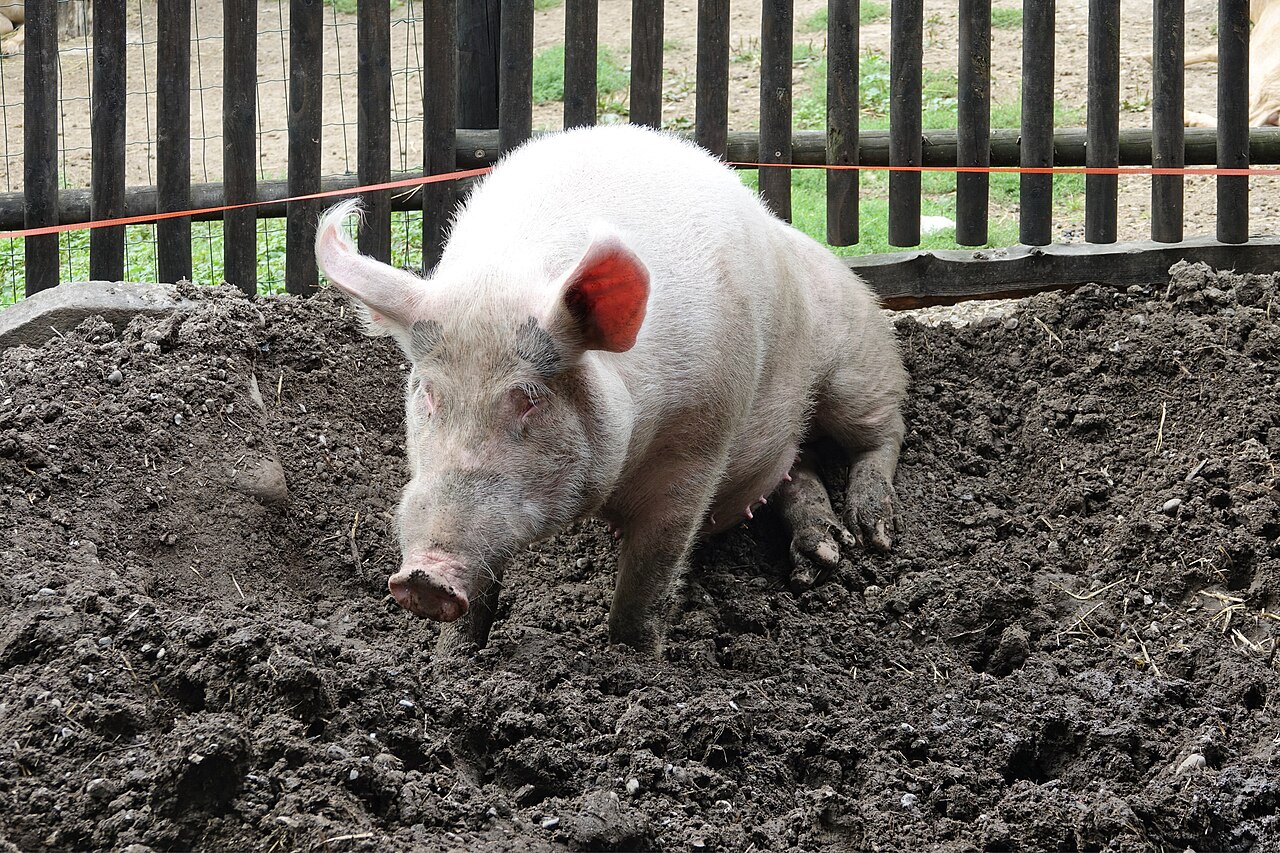
- Photo: Gzen92, CC BY-SA 4.0

Global averages across farms and countries (Poore & Nemecek 2018); a single product can be well above or below them. Not advice for any one person.